
Pillar: No-Code OSS
The OSS Costs, Risks, and Friction Continuums
This post explores how Symphonica tackles the challenges highlighted by Ryan Jeffery, focusing on reducing friction and hidden costs in OSS projects.
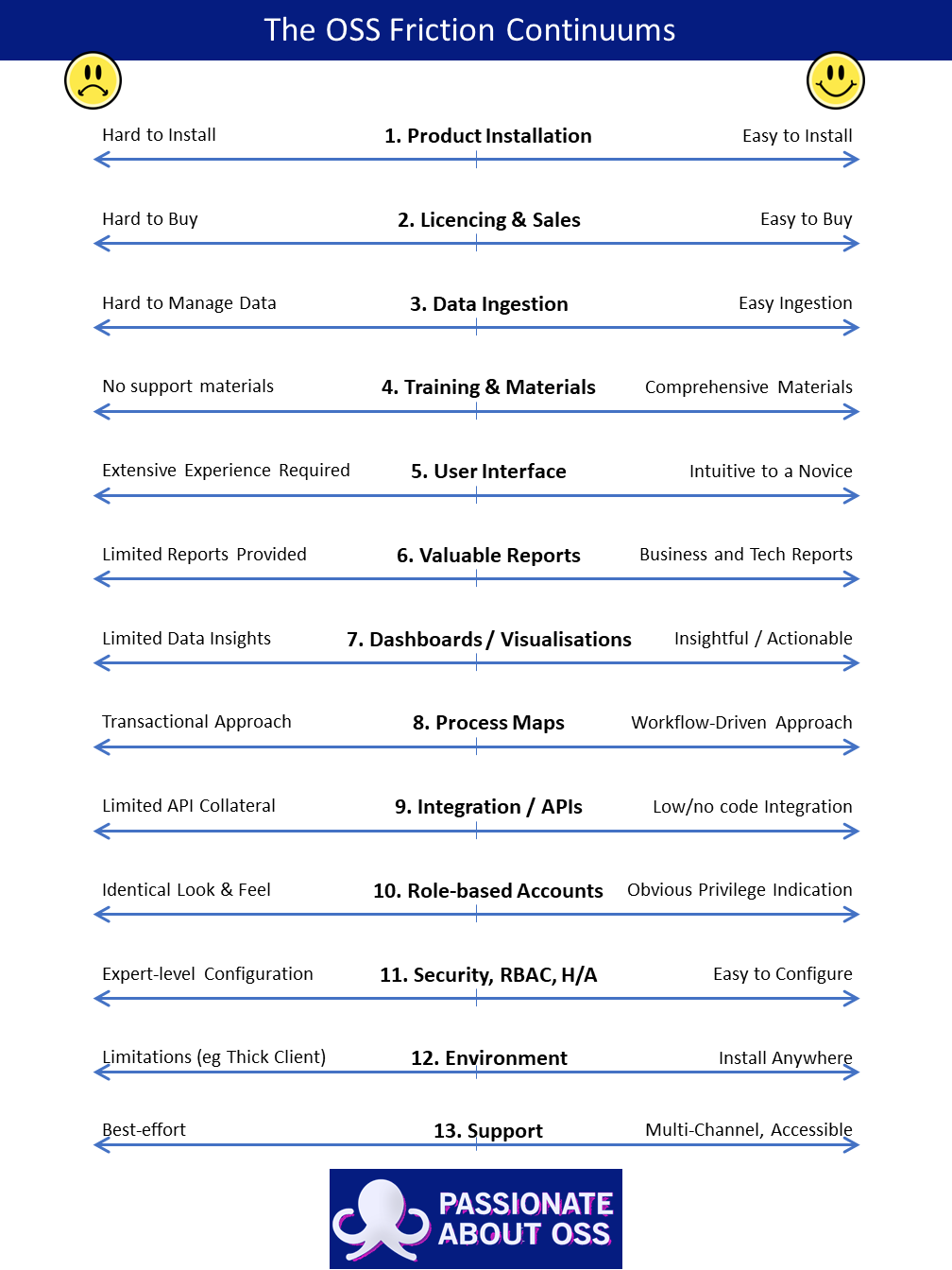
Image Source: Passionate about OSS
Ryan Jeffery’s Closing the Chasm series is a brilliant exploration of the complexities and challenges that exist between OSS buyers and sellers. His insights are not only sharp but also incredibly practical, offering both Buy-Side and Sell-Side constituencies a roadmap to better collaboration and more successful outcomes.
In this series, Ryan introduces the critical concepts of OSS friction and the hidden costs that often catch organizations off guard. The “OSS Friction Continuums” map out areas where projects can stall, such as complex installations or convoluted integrations, while hidden costs highlight the ongoing expenses beyond the initial purchase, such as vendor lock-in and expensive customizations and maintenance. Together, these ideas emphasize the importance of selecting a solution that minimizes friction and hidden costs to ensure smoother, more cost-effective OSS transformations.
This post explores how Symphonica tackles the challenges highlighted by Ryan Jeffery, focusing on reducing friction and hidden costs in OSS projects. We also introduce additional factors critical to the success of digital transformation, ensuring that our customers gain the agility and flexibility necessary to thrive and grow in the telecom industry. Symphonica’s approach empowers CSPs to transform their companies with confidence and efficiency.
Symphonica and The OSS Friction Continuums
Here’s the list of 13 OSS friction continuums proposed by Ryan Jeffrey on his series, and how Symphonica approaches each one of them.
1. Symphonica and Product Installation
Complex installations can lead to significant delays and require additional procurement processes as well as extensive technical resources, adding both time and cost to OSS projects. As an example, on-prem installations often require the procurement and deployment of multi-node third-party databases, operating systems, and even hardware.
Symphonica’s cloud-native multi-tenant architecture and all-inclusive Software-as-a-Service business model simplifies this process, ensuring a quick and straightforward installation. By eliminating the need for complex setups and minimizing configuration requirements, Symphonica enables installation and basic configuration in minutes rather than months, drastically reducing installation friction.
2. Symphonica and Licensing & Sales Models
Opaque and complex licensing models often result in unforeseen costs and complicate scaling efforts.
Symphonica addresses this challenge with a transparent, all-included subscription-based model that is easy to understand and scales based on consumption. In a nutshell, Symphonica subscription packages allow up to a specific number of transactions per month. All the updates, customer support, use cases, and integrations are included in the subscription.
This FinOps-friendly approach eliminates unexpected financial burdens, making it easier for CSPs to manage costs and plan for growth.
3. Symphonica and Data Ingestion
Integrating and ingesting data from various sources can be a time-consuming and error-prone process, often delaying project progress.
Symphonica provides a no-code, AI-driven data ingestion module that automatically detects the format of the incoming data and translates it into a call to the appropriate workflow, streamlining data integration and automatically adjusting for updates or sudden changes at the source.
This ensures quick and efficient ingestion from a wide variety of sources, minimizing friction and accelerating time-to-value.
4. Symphonica and Training & Materials
Inadequate training resources and steep learning curves can slow down the adoption of OSS platforms and increase ongoing support needs.
Symphonica overcomes these challenges by providing comprehensive training resources, including detailed documentation and video tutorials. Its intuitive, no-code interface further reduces the learning curve, making the platform accessible even to those without deep technical expertise.
5. Symphonica and the User Interface
Complicated user interfaces can hinder efficiency and frustrate users, increasing the time and effort needed to manage OSS tasks.
Symphonica’s no-code, AI-driven interface is designed with user experience in mind, offering a highly intuitive environment. Furthermore, the AI co-pilot helps create the initial configuration of any connectors just by uploading the documentation for the network element or a previous integration. It also automatically creates workflows and automations and proactively provides suggestions for improvements.
This enables users to navigate and manage workflows and integrations with ease, significantly reducing friction in day-to-day operations.
6. Symphonica and Valuable Reports
A lack of insightful, customizable reports can make it difficult for organizations to gain actionable insights and make informed decisions.
Symphonica addresses this by providing customizable, insightful reports that cater to both business and technical needs. For customers who want to integrate their own analysis tools, consolidate data in a centralized data lake, or be able to add deep functionality to other systems. Symphonica also provides read-only access to the customer data through standard SQL queries.
These tools deliver actionable insights that help CSPs make informed decisions quickly, aligning operational performance with strategic objectives.
7. Symphonica and Dashboards/Visualizations
Limited or poorly designed dashboards can obscure key metrics and hinder decision-making. Symphonica offers highly customizable dashboards that provide clear, actionable visualizations of data, enabling CSPs to monitor network performance, service provisioning, and customer experience efficiently.
8. Symphonica and Process Maps
When processes are not clearly mapped, it can lead to inefficiencies and errors. Symphonica’s no-code workflow designer allows CSPs to visually create, customize, and optimize process maps, supporting continuous improvement and rapid adaptation to changing business needs.
9. Symphonica and Integration/APIs
Complex integrations can lead to delays, increased costs, and operational inefficiencies in OSS projects.
Symphonica excels in integration, offering a no-code solution that ensures smooth interoperability across diverse technology environments. Our customers can create custom connectors to any network element, IT system or cloud service, with point-and-click ease and the help of an AI co-pilot that reads and understands target system documentation.
By supporting a broad range of APIs, Symphonica significantly reduces the friction associated with complex OSS integrations.
10. Symphonica and Role-Based Access & Security
Poorly designed access control systems can create security vulnerabilities and complicate user management.
Symphonica offers a robust and easy-to-understand role-based access control (RBAC) system with strong security measures. This system simplifies access management while maintaining a secure operational environment, ensuring that users have the appropriate access without adding unnecessary complexity.
11. Symphonica and Security & H/A
Security and high availability are critical in OSS environments.
Symphonica leverages the benefits of its cloud-native architecture to incorporate strong security protocols and a highly available architecture, ensuring the continuous and secure operation of network services without adding complexity.
Furthermore, the multi-tenant approach allows us to consolidate the investment in a strong security team and threat monitoring and prevention systems that focuses on a single architecture instead of otherwise having to divide its attention into multiple, scattered on-prem deployments.
12. Symphonica and Varied Environments
Deploying OSS in varied environments can be challenging, especially when different setups are required.
While we recommend the public-cloud approach, for Tier-1 deployments, Symphonica’s design allows it to be seamlessly installed in any environment—whether public, private, or hybrid cloud—providing the flexibility needed for modern telecom operations.
13. Symphonica and Support
Inadequate support can leave organizations struggling to resolve issues, leading to delays and increased operational costs.
Symphonica provides multi-channel, carrier-class SLA support, ensuring that CSPs have the resources and assistance they need at all stages of their OSS transformation. Depending on the consumption level, Symphonica will assign a Customer Success Team to help the customer navigate through day-to-day operations and get the most value from the platform.
This responsive support system is designed to be effective, reducing the friction that can arise from inadequate vendor support.
Additional Challenges for OSS Buyers
While Ryan’s Continuums cover the most critical aspects, in follow-up discussions and articles, he also notes that there are additional hidden costs and challenges that OSS buyers should consider. Here’s the list of additional challenges pointed by Ryan as well as by other experts that joined the discussion.
Vendor Lock-In
Legacy vendors can severely limit flexibility, locking CSPs into long-term commitments with slow updates and costly customization and configuration services that can only be procured from them.
Symphonica’s no-code approach means that any customer, consultant, or partner can create and update workflows, processes, and integrations, thus eliminating vendor lock-in, reducing costs, and enabling greater operational freedom.
Implementation Delays
Delays in OSS deployment can lead to significant hidden costs, frustration, and career consequences. This is actually one of the biggest fears confronted by the buyer.
At Symphonica, we are obsessed with delivering on-time and with maximum customer satisfaction. During years of iterations we have streamlined our processes to achieve a 99% on-time delivery, no-matter-what.
The no-code OSS approach was actually invented as an initiative stemming from this obsession, in an effort to simplify integrations and remove the off-shore developers required to create the so-called “cartridges”.
We are so confident in our ability to deliver on-time that we support our brand promise by offering up to a $1 million on-time delivery guarantee.
Customization
Expensive modifications are often required to tailor legacy systems to specific needs, including the development of new workflows or connectors to different technologies.
Symphonica’s no-code framework drastically reduces the need for costly customizations, making it easier and cheaper to adapt the platform to unique requirements.
Agility
The cost of customization is not just the price. Rapid iteration is essential to compete in today’s market. Legacy systems that require months for updates can’t keep up with the pace required to be successful.
Symphonica’s no-code, AI-driven platform supports quick iterations for continuous improvement, allowing new services and updates to be launched in days instead of months.
Ongoing Maintenance and Solution Longevity
Continuous updates and support for traditional OSS can lead to escalating costs over time.
Symphonica simplifies ongoing maintenance with its all-inclusive Software as a Service approach, reducing the complexity and expense of keeping systems up to date.
Cloud-Native vs. Cloud-Enabled
True cloud-native platforms like Symphonica are built from the ground up for the cloud, unlike cloud-enabled systems that are retrofitted legacy platforms.
Symphonica offers scalability, flexibility, security, and cost-efficiency that cloud-enabled solutions can’t match.
Try it yourself with a free Pilot
Does this sound too good to be true? We get you. It’s been decades with legacy stuff. Let us show you the next generation of OSS.
Call us today to set up a proof-of-concept to automate any manual process, launch a new service, or a straight-forward pilot to compare side-by-side with your current solution.
Welcome to Symphonica. Welcome to the Agile Telecom Generation!
Explore the Continuums in Depth!
Dive into our blog series to discover how Symphonica drives seamless automation and innovation
- Instant OSS: How Symphonica eliminated the Exhausting OSS Installation Challenges
- The Transparency of OSS Licensing with Symphonica
- Revolutionizing Data Ingestion with Symphonica
- Streamlining Training and Onboarding with Symphonica
- Improving Agility with Symphonica’s Intuitive User Interface
- Unlocking Insights with Symphonica’s Valuable Reports
- Better Decisions with Symphonica’s Dashboards
- Mapping Success with Symphonica’s Process Maps
- Seamless Integration with Symphonica’s No-Code API Solution
- Securing Access with Symphonica’s Role-Based Access Control
- Ensuring Reliability with Symphonica’s Security and High Availability
- Flexible Deployment with Symphonica’s Multi-Environment Capability
- Ensuring Success with Symphonica’s Comprehensive Support
- Breaking Free from Vendor Lock-In with Symphonica
- Up to $1-million On-Time Delivery Guarantee
- Making Customization Affordable and Flexible with Symphonica
- Driving Agility with Symphonica’s Rapid Iteration Capabilities
- Simplifying Ongoing Maintenance with Symphonica
- Leverage the Real Cloud benefits with Symphonica